Understanding the differences between tableware materials
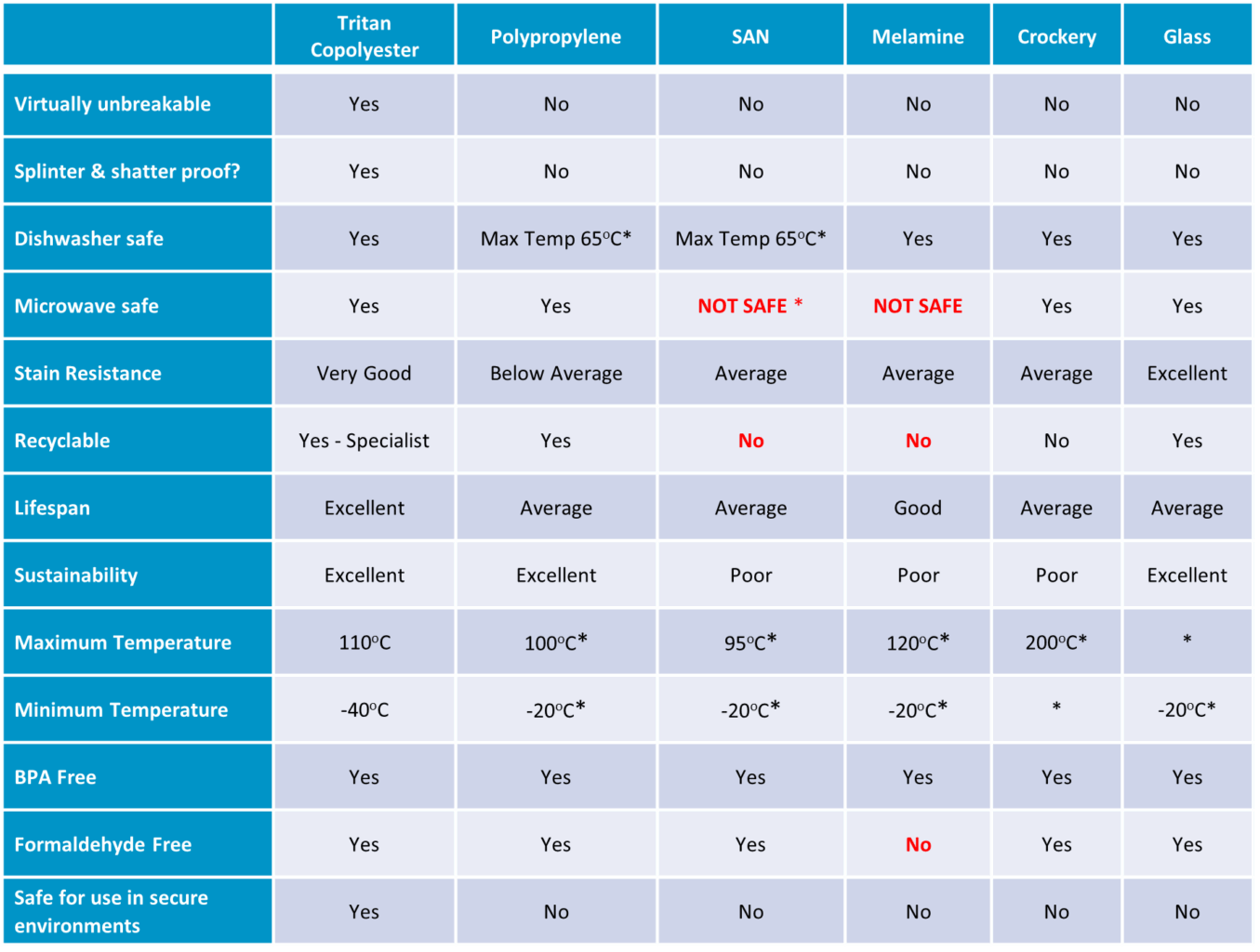
Choosing the right tableware material is about more than appearance alone. In professional environments, materials need to perform well day after day, withstand repeated washing, and remain practical for the way they are used.
That is why not all materials are equal.
Some offer a premium appearance but are heavier or more fragile. Some are more economical but better suited to lighter-duty use. Others provide the best balance of durability, appearance and long-term professional performance.
For Harfield customers, the most important point is that the right choice depends on what matters most in your environment. That may be durability, presentation, weight, cost, safety, or the desire to move to a BPA-free material.
Polycarbonate: still the benchmark while stocks last
Polycarbonate has long been one of the most trusted materials in professional reusable tableware because it offers an excellent balance of strength, durability and long service life.
For many customers, it remains the best option while stocks are still available. It is a proven material that has performed exceptionally well in demanding environments such as schools, hospitals and other high-use catering settings.
That is why, for customers simply replacing worn or damaged items, polycarbonate often remains the best choice in the short term while stocks last.
Copolyester: the best BPA-free alternative
For customers who would prefer a BPA-free option, Harfield sees copolyester as the best alternative to polycarbonate for many applications.
Copolyester offers the closest overall balance of qualities that professional users expect from high-quality reusable tableware. It combines a strong, modern appearance with excellent durability and is well suited to repeated professional use.
In practical terms, it is the best choice for customers who want a BPA-free material without moving too far away from the quality, reliability and presentation they are used to.
That is why Harfield sees copolyester not simply as an alternative, but as the best forward-looking option for many products in the range.
Polypropylene: practical and economical
Polypropylene has an important place in reusable tableware, particularly where practicality and value are the main priorities.
It can be a very good option for products where a more economical solution is appropriate. However, it is not always the closest like-for-like replacement for polycarbonate.
For customers looking for a premium, high-performance reusable solution, copolyester is generally the stronger option. For those looking for a more basic and cost-conscious product, polypropylene may have a useful role to play.
Melamine: familiar, but not Harfield’s preferred direction
Melamine is a material many buyers will recognise, particularly in catering and dining environments. However, familiarity does not necessarily make it the best long-term choice.
For Harfield’s markets, we believe copolyester is the better BPA-free option for customers seeking a premium replacement for polycarbonate. It is a more future-facing material choice and better reflects the combination of durability, appearance and long-term professional suitability that many customers are looking for.
Where the priority is to move forward with confidence and choose a material that supports both performance and reassurance, Harfield sees copolyester as the stronger route.
Crockery: suitable for some settings, but not ideal for all
Crockery may suit some dining environments where weight, breakability and replacement cost are less of a concern. However, in many professional settings it is not the most practical option.
Compared with reusable plastic tableware, crockery is heavier, breakable and often less suited to busy, high-volume service. In sectors such as education and healthcare, these differences can have a real impact on safety, ease of handling, replacement rates and long-term value.
For many customers, particularly those operating in demanding day-to-day service environments, durable reusable plastic tableware remains the more practical and reliable choice.
The best material depends on your priorities
Every material has strengths, but not every material is right for every application.
If your priority is to continue with the proven performance of polycarbonate, that remains the best option while stocks are available.
If your priority is to move to a BPA-free alternative without stepping down in overall quality, copolyester is the best choice.
If your priority is economy and practicality in more basic applications, polypropylene may also be worth considering.
The purpose of this comparison is not simply to list materials, but to help you choose the one that best fits your environment, your service style and your expectations for long-term performance.
Need help choosing?
If you are unsure which material is right for your application, Harfield can help.
We understand that different sectors and products have different priorities, and we can guide you towards the option that offers the right balance of performance, presentation and long-term value.
Contact us today for advice on the best material for your tableware requirements.